Applying Kress & van Leeuwen's model of reading images to the following:

incongruously yields
- the point of departure, christianity, as new and ideal
- the endpoint, atheism, as given and real.

Halliday, M A K 1981 (1965) Types of Structure. M A K Halliday & J R Martin [Eds.] Readings in Systemic Linguistics. London: Batsford. 29-41.Halliday, M A K 1979 Modes of meaning and modes of expression: types of grammatical structure, and their determination by different semantic functions. D J Allerton, E Carney, D Holcroft [Eds] Function and Context in Linguistics Analysis: essays offers to William Haas. Cambridge: Cambridge University Press. 57-79Rose, D 2001 The Western Desert code: an Australian cryptogrammar. Canberra: Pacific Linguistics.
The nominal group, as we have seen, construes an entity — something that could function directly as a participant.

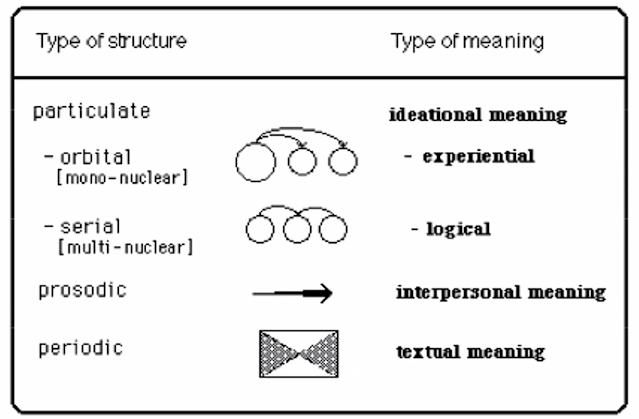
In the logical mode, reality is represented in more abstract terms, in the form of abstract relations which are independent of and make no reference to things. …
Since we are claiming these structural manifestations are only tendencies, such an argument is only tenable on the grounds that the type of structure that is generated by the logical component is in fact significantly different from all the other three. The principle is easy to state: logical structures are recursive. …
True recursion arises when there is a recursive option in the network, of the form shown in Figure 14, where A:x,y,z… n is any system and B is the option ‘stop or go round again’. This I have called “linear recursion”; it generates lineally recursive structures of the form a₁ + a₂ + a₃ + . . . (not necessarily sequential):
… Logical structures are different in kind from all the other three. In the terms of systemic theory, where the other types of structure – particulate (elemental), prosodic and periodic – generate simplexes (clauses, groups, words, information units), logical structures generate complexes (clause complexes, group complexes, etc.) (Huddleston 1965). … While the point of origin of a non-recursive structure is a particular rank – each one is a structure “of” the clause, or of the group, etc. – recursive structures are in principle rank-free: coordination, apposition, subcategorisation are possible at all ranks.
Postscript:
In his seminar paper (13/8/21) on 'construing entities', Martin claimed that there are no recursive networks anywhere in the SFL literature. The network above occurs in one of the references he provided.
Instantiation also opens up theoretical and descriptive space for considering commitment (Martin 2008, 2010), which refers to the amount of meaning instantiated as the text unfolds. This depends on the number of optional systems taken up and the degree of delicacy pursued in those that are, so that the more systems entered, and the more options chosen, the greater the semantic weight of a text (Hood 2008).


