The Thought Occurs

Showing posts with label Metafunction. Show all posts

Thursday, 15 January 2026

From Potential to Readiness: Clarifying Systemic Disposition in SFL Theory

The notion of potential occupies a central role in systemic functional linguistics, but its conceptual status has long been prone to imprecision. Often, potential is metaphorically treated as a reservoir or storehouse of forms, as if instances are drawn from a static inventory. Halliday himself warned against this reading. In fact, he explicitly characterises potential as a subtype of readiness within the system of modulation—that is, in constructions expressing ability, willingness, or inclination (e.g., ready to, able to, willing to). Crucially, Halliday does not extend this characterisation to the broader theory of language; he does not describe meaning potential in general as readiness.

Nonetheless, exploring the implications of treating potential analogically as a structured readiness throughout the SFL system illuminates persistent conceptual ambiguities. This post develops a disciplined, SFL-internal perspective on what follows if we interpret meaning potential in readiness terms.


1. Readiness in Modulation: The Historical Anchor

Within modulation, Halliday’s use of readiness is precise. Modality expresses the speaker’s disposition to act or to construe events: ready, willing, or able. Here, potential is not a state or a store, but a dispositional configuration: a structured readiness that combines inclination (the directional tendency) and capacity (the structural ability to realise the meaning). This historical anchor legitimates extending the concept analogically to broader meaning potential.


2. Extending Readiness to Meaning Potential

Interpreting meaning potential as readiness involves conceptualising the system as a dispositional field:

  • Inclination: tendencies within the system toward particular construals or semiotic configurations.

  • Capacity: structural resources that permit certain actualisations while precluding others.

Readiness thus reframes potential from a metaphorical reservoir into a systematic orientation toward instantiation. This does not claim Halliday explicitly extended readiness to meaning potential; it simply uses the logic of modulation as a productive lens for clarifying systemic potential.


3. Implications for the Cline of Instantiation

The cline of instantiation, central to SFL, can be reconceived as a gradient of dispositional specificity.

  • At the system end, readiness is broad, generalised, and unspecialised.

  • At the instance end, readiness is contracted and aligned with particular situational conditions.

This reading clarifies why the system cannot be treated as a set of actual examples. It reinforces Halliday’s point that instantiation is not abstraction but the actualisation of systemic potential in context.


4. Contextual Potential: Field, Tenor, and Mode

Extending the readiness lens to context illuminates SFL’s semiotic stratification:

  • Field: readiness to enact specific types of activity.

  • Tenor: readiness to enact particular interpersonal relations.

  • Mode: readiness to organise discourse in particular ways.

This perspective corrects a common pedagogical confusion: context is not an environment to be represented; it is semiotic potential realised through readiness across the strata.


5. Linguistic Potential: Lexicogrammar

Lexicogrammar can similarly be seen as a dispositional system:

  • Its inclinations direct the system toward particular semantic construals.

  • Its capacities constrain which meanings can be realised in which configurations.

System networks are not inventories of forms; they are metastable patterns of readiness, explaining why delicacy reflects precision of readiness, not mere addition of options.


6. Readiness and the Cline of Individuation

Variation in SFL presupposes individuation—the distribution of potential across members of a community.

  • Collective potential represents the total semiotic readiness of the community.

  • Individual potential represents the subset of readiness accessible to a particular user.

  • Variation arises from differential access and stability of individual readiness configurations across different contexts.

Viewing meaning potential as readiness clarifies individuation: individuals are not repositories of forms; they are sites where portions of collective readiness are stabilised and selectively actualised. This interpretation remains fully canonical, fully SFL-internal, and avoids metaphysical or relational assumptions.


7. Implications for Variation

With readiness understood as distributed potential, register and dialectal variation become intelligible as systematic differences in semiotic readiness:

  • Register variation: differing distributions of readiness across situation types.

  • Idiolectal variation: relative stability of an individual’s readiness configurations.

The reading avoids the mistaken notion that individuals “store” forms; rather, their usage reflects the configuration of distributed readiness in context.


8. Consequences for Metafunctions

Metafunctions can also be read through readiness:

  • Experiential: readiness to construe processes and relations.

  • Interpersonal: readiness to enact alignment and negotiation.

  • Textual: readiness to organise discourse and maintain coherence.

This perspective clarifies why metafunctions are inseparable yet analytically distinct domains of system potential.


9. The Payoff: A Coherent Internal Model

Viewing potential as readiness, even analogically, strengthens SFL theory internally:

  • Clarifies the cline of instantiation.

  • Sharpens understanding of context-system relationships.

  • Explains variation and register coherently.

  • Aligns closely with Halliday’s pedagogical and theoretical intentions.

Importantly, this remains fully canonical and non-revisionist.


10. Conclusion: Readiness as a Productive Clarification

Halliday did not claim that meaning potential equals readiness. However, interpreting potential analogically as structured readiness provides a clearer, internally coherent framework for understanding instantiation, variation, and individuation within SFL. It shows how the system, the context, and the individual user are all dispositional actors in the realisation of meaning, without departing from canonical SFL principles.

This clarification strengthens the conceptual integrity of SFL while remaining historically accurate, pedagogically clear, and theoretically tight.

Monday, 22 January 2024

Friday Research Student Course Semester 1 2024

James Martin wrote to asflanet on 21 Jan 2024, at 11:20:

Hi all

This semester's course will be convened by me, with a focus on axial argumentation in linguistic descriptions informed by SFL. We'll begin with an introduction to system/structure relations in SFL, before moving on to modelling the relation of axis to basic theoretical dimensions of SFL (i.e., rank, metafunction and stratification).

The course assumes familiarity with Halliday's description of English grammar, up to the level of delicacy canvassed in Martin et al.'s 2010 Deploying Functional Grammar workbook.

The course is open to all research students. There is no need to register; simply come along to the first meeting Feb 23, at 2pm, in Quad Seminar Room 204 (Oriental Room).

There is no auditing or on-line participation for this course – all students are expected to attend in person and do the coursework assigned; completed assignments will be submitted to the course instructor and their supervisors (with formal assessment undertaken by their supervisors).

Bring some paper and writing instruments to practice network drawing.

Cheers
Jim


Blogger Comments:

For some of the theoretical misunderstandings that Martin will be inculcating in students in this course, see the review of Systemic Functional Grammar: A Next Step Into The Theory — Axial Relations.

For some of the theoretical misunderstandings in Martin et al.'s 2010 Deploying Functional Grammar workbook, see the meticulous review here.

Wednesday, 6 July 2022

The Realisation Of The Metafunctions In Phonology

At the rank of tone group:
  • the system of TONALITY — choice in the distribution of tone groups — realises the distribution of information units (textual metafunction);
  • the system of TONICITY — choice in the placement of tonic prominence — realises the culmination of New information (textual metafunction);
  • the system of TONE — choice in the major pitch movement — realises the system of KEY (interpersonal metafunction);
  • the systems of TONE SEQUENCE and TONE CONCORD realise the systems of TAXIS and LOGICO-SEMANTIC TYPE (logical metafunction).

Tuesday, 5 July 2022

The Global And Local Dimensions That Define The Architecture Of Language

Halliday & Matthiessen (2014: 20, 31-2)
… We have now introduced the major semiotic dimensions that define the ‘architecture’ of language in context. Some of these dimensions enable us to locate lexicogrammar in relation to the other sub-systems that make up the total system of language; these are known as global dimensions because they determine the overall organisation of language in context: the hierarchy of stratification, the cline of instantiation, and the spectrum of metafunctions. The other dimensions enable us to characterise the internal organisation of lexicogrammar and also of the other sub-systems of language, and of context; these are known as local dimensions because they operate locally within linguistic sub-systems. Let us summarise the semiotic dimensions of language in context under these two headings: see Table 1-7. 

Tuesday, 31 August 2021

Theoretical Problems With Doran's 'Factoring Out Structure: Nuclearity, Linearity And Iteration'

Factoring out structure: Nuclearity, linearity and iteration

Yaegan Doran:
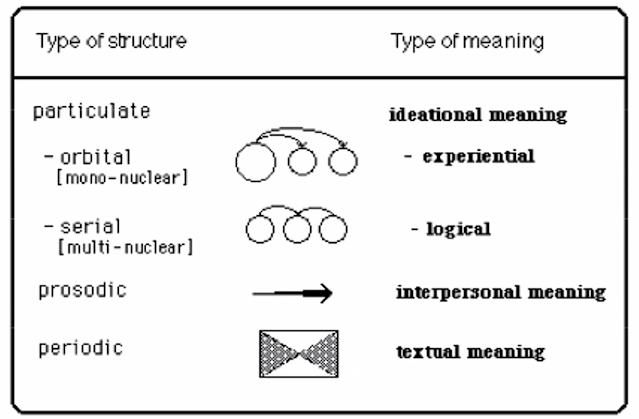
Like much of its framework, SFL offers a very elaborate model of structure. Its metafunctional distribution of periodic, prosodic and particulate structures is well known, with numerous distinctions within each type (Halliday 1979). Focusing on particulate structures, Halliday distinguishes between multivariate and univariate structures, and within univariate structures, between hypotactic and paratactic structures (Halliday 1965, Halliday and Matthiessen 2014), while Martin (1996) conceptualises particulate structures as involving orbital and serial relations (Martin 1996). Similarly, relations in discourse are alternatively conceptualised from the perspective of grammar as non-structural (Halliday and Hasan 1976) or from discourse semantics as involving co-variate structures (Martin 1992, adapted from Lemke 1985).  
Many of these types of structure are sharply distinct, while others have significant overlap. Together, they account for a wide range of linguistic phenomena and do a good job at describing the patternings that occur across regions of language. However as SFL has expanded its descriptive framework into a wider range of languages, it has been clear that there are grammatical constructions that are not quite accounted for. Building upon this work, this talk offers a generalised model of particulate structure, developed with Jim Martin, that aims to cover a wider range of grammatical patterns. 
This model does not start with types of structure, but rather with three sets of factors that can be combined relatively freely: whether the structures involves a nucleus and subordinate satellites (nuclearity), whether there is linear interdependency between the elements in the structure (linearity), and whether the relations can occur more than once (iteration). These factors generate a wider set of structures than so far acknowledged explicitly in SFL. Together, they offer a means of seeing both the differences between types of structure already acknowledged, as well as variation within them. They also generate structures that account for phenomena not yet considered structurally in SFL to date
The goal of this talk is build more explicitness in SFL’s model of structure as it continues its descriptive expansion and in doing so, help clarify issues that have often been left aside in SFL grammatical description. Where possible, the model will be exemplified through English but I will bring in other languages as need be.


Blogger Comments:

[1] To be clear, Halliday soon after revised his model of grammatical structure types in favour of the current typology. Halliday (1994: 36) :

[2] To be clear, as demonstrated here and here, Martin's orbital vs serial distinction purports to model the structural distinction for the experiential vs logical metafunctions, but actually models the distinction between hypotaxis (nucleus vs satellite status) and parataxis (nuclei of the same status).

[3] To be clear, these are cohesive relations at the level of lexicogrammar, and Halliday & Matthiessen (2014) provides an updated interpretation.

[4] To be clear, by 1992, Lemke had already recanted his view that 'covariate' was a type of structure. Lemke (1988: 159):

My own 'covariate structure' (Lemke 1985), which includes Halliday's univariate type, is for the case of homogeneous relations of co-classed units, and should perhaps be called a 'structuring principle' rather than a kind of structure.

[5] To be clear, this remains a bare assertion until it is supported by evidence. The previous attempt to provide such evidence, Martin's seminar of 13/8/21, was demonstrated to be based on theoretical misunderstandings (see here).

[6] To be clear, Doran's work builds on Martin's misunderstanding of structure; see [2].

[7] To be clear, here Doran is modelling metalanguage (SFL Theory), not language, by essentially devising a metalinguistic system of features ("factors") that generates types of structure, as if metalanguage were language.

[8] To be clear, each of these factors is theoretically problematic.

Firstly, nuclearity corresponds to Martin's orbital structure, which purports to be a model of experiential structure, but is actually a model of logical hypotaxis (independent nucleus vs dependent satellites). That is, nuclearity misconstrues a multivariate structure as a univariate structure.

Secondly, linear interdependency is just interdependency. The word 'linear' is redundant, since all structures are linear. (For Halliday (1965), univariate structures are lineally recursive.) Linear interdependency corresponds to Martin's serial structure, which purports to be a model of the univariate structure of the logical metafunction, but is actually just a model of one of its dimensions: parataxis (multiple nuclei of the same status).

Thirdly, in SFL Theory, iteration describes the type of structure favoured by the logical metafunction (Halliday (1994: 36). The purpose of introducing Halliday's term here is to provide the possibility of 'iterative nuclearity' and 'non-iterative linear interdependency'; see [9].

To summarise, Doran's three factors actually concern:

  • hypotactic interdependency
  • paratactic interdependency
  • interdependency in general.

[9] To be clear, this "wider set of structures" includes iterative multivariate structures and non-iterative univariate structures (subjacency duplexes), neither of which withstands close scrutiny, as demonstrated here.

[10] To be clear, these phenomena include structure markers misconstrued as units in unit complexes, as in Martin's notion of a subjacency duplex.


Postscript:

The theoretical misunderstandings in this seminar turned out to be so complicated, that the paper is now being examined, slide by slide, here.

Saturday, 21 August 2021

One Of The Problems With Martin's Model Of Structure Types

Martin (1996) characterises metafunctional structures as follows:


However, Martin's structural distinction between experiential and logical meaning actually construes the distinction between unequal status (of nucleus vs satellite) and equal status (of multiple nuclei). That is, Martin's structure typology misconstrues the metafunctional distinction between experiential and logical as the logical distinction between hypotaxis and parataxis. If using Martin's model has led to confusion, this is one possible reason.

Saturday, 24 November 2018

Today's 'Typology Forum' Paper By David Rose

The textual metafunction: making matter mean

David Rose
University of Sydney
The textual metafunction is sometimes presented as if it were an afterthought, there merely to organise interpersonal and ideational meanings into convenient structures of clause and text. But in the first stages of language, and in much of everyday discourse, it is the primary means of turning the world into meaning, with exophoric reference to the shared sensations of me and you, this and that, here and there. Once the world gets classified, and configured into clauses, and strung out into texts, the same resources used to indicate the world around us are re-deployed to indicate the semiotic world within a text. Where once there were only signs, now meanings come in messages, each of which must be sensible in the unfolding world of the text, and manage listeners’ attention to the information they present. 
Textual typological studies might start from observing these three general functions: introducing and tracking meanings through a text, or phoricity, contextualising messages, or thematicity, and managing information prominence, or newsworthiness. Resources for realising these functions are prototypically distributed between language strata: phoricity in the reference chains of discourse, thematicity in segmental structures of clauses, and newsworthiness in periodic structures of tone groups. But while they are in principle independently variable, both the functions and their realisations interact with each other, and variations in textual functions proliferate as a result. Perhaps also as a consequence of these interactions, their realisations come to vary across languages and registers. 
This paper will make some general observations about interactions between phoricity and thematicity and between thematicity and newsworthiness, and will exemplify variations in these interactions between languages. In the process, it will also illustrate textual variations in register, from dialogue to monologue, and from accompanying to constituting fields.


Blogger Comments:

[1] Rose's negative appraisal — implied by 'afterthought' and 'merely' (counter-expectancy: limiting) — of an unsourced characterisation of the textual metafunction is unjustified. Halliday & Matthiessen (1999: 398):
The textual metafunction is second-order in the sense that it is concerned with semiotic reality: that is, reality in the form of meaning. This dimension of reality is itself constructed by other two metafunctions: the ideational which construes a natural reality, and the interpersonal, which enacts an intersubjective reality. The function of the textual metafunction is thus an enabling one with respect to the rest; it takes over the semiotic resources brought into being by the other two metafunctions and as it were operationalises them.
[2] Here Rose confuses the ideational and textual metafunctions.  It is the ideational metafunction that construes experience as meaning ("turns the world into meaning").

[3] As Halliday & Matthiessen (1999: 530) point out, the textual metafunction only operationalises the resources already created by the other metafunctions:
Reference is a way of referring to things that are already semiotically accessible: either actually, in the text, or potentially, in the context of situation.
[4] To be clear, "classifying the world" is construing experience as ideational meaning.

[5] To be clear, it is experiential options that are "configured into clauses", and "configured" takes a structural (syntagmatic) rather than systemic (paradigmatic) perspective on the clause.

[6] To be clear, it is meaning that is "strung out into texts", through the process of instantiation during logogenesis.

[7] To be clear, these resources are ideational potential, construed of experience, and on the SFL model, they do not "indicate" the world, since there are no meanings outside semiotic systems that can be "indicated".

[8] To be clear, in theoretical terms, this "redeployment" is the process of instantiation during logogenesis.

[9] To be clear, in theoretical terms, "indicate" here refers to the logical projection of second-order meaning.

[10] To be clear, in SFL terms, this is the semogenic distinction between protolanguage ("signs") and language ("messages"), though there is no reason to think that this is Rose's meaning.

[11] Here Rose switches to promoting Martin's work on textual systems, as if the preceding paragraph leads naturally to them, and as if they address the (confused) issues he has raised.

[12] This misrepresents the model in Martin (1992).  The meanings that are introduced and tracked are participants, and the system for doing so is termed IDENTIFICATION, not phoricity.  Martin's model is Halliday & Hasan's (1976) model of cohesive reference, misunderstood, rebranded and relocated from lexicogrammar to discourse semantics (evidence here).  Essentially, Martin confuses
  • textual reference with reference in the sense of ideational denotation, like his source Du Bois (1980),
  • interpersonal deixis of nominal group structure with non-structural textual reference, and, as a result,
  • nominal groups realising participants with reference items,
which is why the experiential feature 'participant' is presented (Martin 1992: 325) as the unit and entry condition of this textual discourse semantic system.

[13] These refer to Martin's (1992) reworkings of Halliday's THEME and INFORMATION, which confuse linguistic theory (Theme, New) with writing pedagogy, namely:
  • introductory paragraph, rebranded as Macro-Theme, 
  • topic sentence, rebranded as Hyper-Theme (misunderstood from Daneš (1974)), 
  • paragraph summary, rebranded as Hyper-New, and 
  • text summary, rebranded as Macro-New.
Evidence here.

[14] In SFL theory, these are all systems of the lexicogrammatical stratum.

[15] In SFL theory, reference chains represent (non-structural) cohesive relations within the lexicogrammar.

[16] The claim that thematicity is "distributed" in segmental structures is not only inconsistent with SFL theory, but also with Martin (1992), and most notably with Martin & Rose (2007), where such structures are modelled as waves in a chapter titled Periodicity.

[17] This follows Martin (1992: 384) in confusing the content plane (INFORMATION is a lexicogrammatical system) with the expression plane (the tone group is a rank unit of the phonological stratum).

[18] The notion of "interaction" between strata — different levels of symbolic abstraction — repeats Martin's (1992: 488) misunderstanding of the dimensions of the SFL theoretical architecture as modules.  See the explanatory critiques here.

[19] To be clear, in SFL theory, because 'register' refers to a functional variety of language, it is modelled as a point on the cline of instantiation.  Here Rose follows Martin (1992) in misconstruing register as a stratum of context, the culture as semiotic system.  See the critiques here.

[20] To be clear, in SFL theory, the dialogue vs monologue distinction is one of MODE, a system of context (culture), not register (language).

[21] The notion of 'constituting field' derives from Martin (1992: 185, 193) where it applies to activity sequences, which are modelled in that work as context (field), misconstrued as register, but in Martin & Rose (2007: 100-3) as discourse semantic.  To complicate matters further, Rose, like Martin, confuses the ideational semantics (that realises a field) with field (misconstrued as register).

Moreover, in presenting this distinction as a textual distinction at the level of context, it invites confusion with Hasan's (1985/9: 58) feature opposition of ancillary vs constitutive LANGUAGE RÔLE in her model of MODE, the textual system at the level of context (culture), not register (language):
First, there is the question of the LANGUAGE RÔLE — whether it is constitutive or ancillary. These categories should not be seen as sharply distinct but rather as two end-points of a continuum.

Sunday, 4 November 2018

Matthiessen On Register (abstract for the 3rd Halliday-Hasan International Forum on Language)


Approaching register trinocularly

Christian M.I.M. Matthiessen
The Hong Kong Polytechnic University


Like many other linguistic phenomena, or indeed more generally semiotic ones, register — or more helpfully, register variation — has proved to be “slippery”. This is partly because semiotic phenomena are inherently hard to pin down: they exist (or unfold) as semiotic phenomena, of course, but at the same time are also (enacted) as social phenomena, (embodied) as biological phenomena, and (ultimately manifested) as physical phenomena. And within their own order of phenomena, while they are located stratally, they derive their value from their stratal neighbourhood, and (crucially) they are extended somewhere along the cline of instantiation. The slippery nature of register is reflected in the history of the term in Systemic Functional Linguistics. Taken from Reid (1956) by Halliday and his colleagues in the 1960s (e.g. Halliday, McIntosh & Strevens 1964; Gregory 1967), the term register meant registerial variation — functional variation in language according to context of use; it reflected the nature of language as an adaptive system. However, in J.R. Martin’s work, the term slipped stratally from language into context, and it came to stand for the contextual variables implicated in functional variation, i.e. field, tenor and mode. Martin has documented this terminological slippage very clearly and carefully (e.g. 1992). So terminologically, we now have two distinct (but related) uses of the term register— its original and still current sense of functional variation, and its later sense as (roughly) situation type. But the phenomenon of functional variation — register variation — is still recognized, regardless of the terminology (cf. Martin 2010). In what follows I use register in its original sense of functional variation.

The slippery nature of the phenomenon of register variation makes me think of one of M.A.K. Halliday’s technical terms, viz. “semantic slime”. He had in mind, in the first instance, the semantic slime that accompanies terms as they slide from everyday use to technical-scientific use; but perhaps we need to recognize such slime also when terms such as register slither from one theoretical area to another. (And of course, “register” is also used with other senses in linguistics, as in phonetics.)
   
Fortunately, SFL comes with a theoretical principle, and method, that enables us to deal with slippery phenomena like register. This is Halliday’s trinocular vision (spelled out by him and others in many places, e.g. Halliday 1978, 1979, 1996; Halliday & Matthiessen 2004). The principle is simple but very powerful: since the systemic functional theory of the “architecture” of language is relational in nature (rather than modular), and is based on intersecting semiotic dimensions like the hierarchy of stratification (cf. Matthiessen 2007), the cline of instantiation and the spectrum of metafunctions, we can shunt along these dimensions (cf. Halliday 1961, on shunting — borrowed from the railways) and adopt different observer points, viewing phenomena trinocularly. Halliday (e.g. 1978) worked this out for the hierarchy of stratification: any phenomenon can be viewed “from above” (from a higher stratum), “from below” (from a lower stratum) and “from roundabout” (from its own stratum, its own primary location). Register variation is semantic variation in the first instance, so its primary location is the stratum of semantics. Consequently, when we view it “from above”, we look at it from the point of view of context, when we view it “from below”, we look at it from the point of view of lexicogrammar (and by further steps, phonology, and then phonetics, or graphology, and then graphetics).

Now, I think that Halliday’s trinocular vision can be applied to all semiotic dimensions, not only to the hierarchy of stratification, where it was first applied. For instance, locally within a stratum, we can use it to move up and down the rank scale as we adopt different views on some particular phenomenon. While I think this is by now a well-known extension of the use of trinocular vision, I believe it is still helpful to view register trinocularly in terms of all the relevant semiotic dimensions, and this is what I propose to focus on in my talk:

·      global semiotic dimensions: 
o   the hierarchy of stratification: register viewed from above — contextual variables and values; register viewed from below — lexicogrammatical realizations (and lower-stratal ones as well); register viewed from roundabout — registers as “meanings at risk”;
o   the cline of instantiation: register viewed from above — from the point of view of the overall meaning potential: registers as subpotentials [with potentially distinct probabilities of instantiation]; register viewed from below — from the point of view of instances of this potential, i.e. texts as flow of meaning: registers as particular patterns (in context of situation), possibly emergent as new adaptations detectable at first as text types [with new relative frequencies]; register viewed from roundabout — the point of view of the mid-region of the cline of instantiation, between potential and instance: registers as systems of semantic strategies adapted to institutional settings (as in Halliday 1973, and Patten 1988).
o   the spectrum of metafunction: all metafunctions (and their contextual correlates) are equally involved in the characterization of register, but we still benefit from viewing registers horizontally as it were — ideationally (logically, experientially), interpersonally and textually.

·      local semiotic dimensions:
o   the hierarchy of rank: any given register will extend across all of the relevant ranks of the semantic rank scale, but we still need to shunt along this hierarchy, viewing texts as instantiating particular registers (and so the registers themselves) both from the highest rank and the lowest rank, making sure that they meet in the middle. (The question whether there is one general semantic rank scale, comparable to the general rank scales in lexicogrammar and phonology is a very interesting one, but a tough one to answer since it depends on extremely extensive analysis of texts from a vast number of different registers, and nobody has even come close in any framework. I suspect it will turn out that the semantic rank scale needs to be differentiated both metafunctionally and registerially. And it is also important to note that rank is as it were experientially biased; the other metafunctional modes have complementary models for dealing with “composition” — including the logical one of complexing, which is what Bill Mann, Sandy Thompson and I focussed on when the developer RST [Rhetorical Structure Theory].)
o   the hierarchy of axis: this hierarchy has only two “values”; but any given register can be viewed from above in terms of systemic organization [paradigmatic axis] and from below in terms of structural organization [syntagmatic axis].
  
If we re-view register trinocularly along the lines that I have suggested, have we covered everything there that needs to be said about register? The short answer is obviously no.

On the one hand, phenomenologically, we also need to consider the ordered typology of systems operating in different phenomenal domains into account, viewing register not only semiotically, but also social, biologically and physically. For example, we need to take account of the role of register in the complex relationship between social hierarchies and the division of labour, noting the way that register variation and dialect variation intersect. (Many of the semiotic upheavals that we witness today can be related to the physical technology of the Internet — i.e. in the first instance (but not only!) to the rapid changes in the channel of the mode variable of context. The ramifications are extensive, just as when the printing press was introduced as another new channel technology.)

On the other hand, to address and take account of all the insightful observations that have been made about register (and also  the potentially misguided ones), we need to go meta — we need to find or create a framework of observations that transcends SFL since a great deal of very valuable work on register has been done and is being done outside SFL, as will be easy to see once the new pioneering journal Register Studies has been launched in 2019).

On the third hand (semiotically, we are not at all limited to our two biological hands — and even this may change Frankenstenially within the biological order of systems if Yuval Noah Harari is on the right track with his vision of Homo Deus, his “history” of tomorrow — which I would call a forecast), there are quite a few phenomena that have yet to be interpreted consensually — like ideology (see Lukin 2019) and individuation (discussed by various contributors to Bednarek & Martin 2010). Ideology and individuation are two of the issues in the exploration of language in context that I pointed to in a talk at ALSFAL XIV hosted by BUAP in Puebla (8-12 October, 2018): “Issues: ideology, individuation, institutions; intervention; impact; implementation”. Time permitting, I will try to touch on these issues since I think they are all central to the theme of this Halliday-Hasan Forum, “Register: New Questions and Possibilities”. One central area of impact is education, and fortunately Kazuhiro Teruya will deal with this area in his talk.

This talk is part of my attempt over the years to contribute to our understanding and investigation of register — e.g. Matthiessen (1993, 2015). The focus on register in this third Forum is very timely, also in view of the launch next year of the new journal Register Studies that I mentioned above. The first issue will include interviews with scholars dealing with register in different traditions and from different point of departure, and my contribution represents SFL; a later issue will include an interview of me about register, conducted by Wang Bo and Helen Ma.