The Thought Occurs

Showing posts with label Structure. Show all posts

Monday, 30 December 2024

Beatriz Quiroz Correctly Identifying A Descriptive Inconsistency Introduced Into IFG3 & IFG4

Beatriz Quiroz wrote to SYSFLING on 27 Dec 2024, at 07:23:

As far as I could recall when I was a grammar tutor un Sydney, both demonstratives and possessives are described as realising the Deictic function (whether they function as Head or as Modifier) in the English nominal group.

In IFG4 this is the case, certainly. The Thing, on the other hand, it's said to be realised by common nouns, proper nouns and personal pronouns (p. 383).

However, on Table 9.9, on reference expressions in English, it's suggested demonstrative 'pronouns' realise the 'Thing/Head' as well (p. 626). Would this mean pronominal uses of demonstratives realise the Thing, not Deictic? Why possessive pronouns would still be analysed as Deictic, according to this table?

Martin et al (2010) (DFG) suggest pronouns could be analysed as Deictic/Thing (although they don't mention pronominal uses of demonstratives and possessives) (p. 167). According to p. 169, however, cases in which demonstratives realise the Head would be treated as elliptical nominal groups without a Thing. This is consistent with how IFG4 treats elliptical nominal groups (p. 390) in the chapter on groups and phrases.

Blogger Comments:

[1] This is all unproblematic.

[2] To be clear, Table 9.9 in IFG4 does analyse a demonstrative pronoun as Thing/Head and not Deictic:

However, this is a theoretical inconsistency introduced into IFG3 and IFG4 by Matthiessen. The source of the inconsistency can be identified by comparing IFG1/2 with IFG3/4. In Halliday (1985: 295; 1994: 313), demonstrative pronouns are characterised as Head, but not Thing:


However, in Halliday & Matthiessen (2004: 556) and Halliday & Matthiessen (2014: 629), Halliday's table has been altered so that demonstrative pronouns serve as Thing, as well as Head:


and it is this misreading of Halliday (1994) that informs Table 9.9 in IFG4.

[3] To be clear, Table 9.9 suggests that possessive pronouns — like mine — would be analysed as Thing/Head, and possessive adjectives — like my — would be analysed as Deictic/Premodifier or Head.

Monday, 22 January 2024

Friday Research Student Course Semester 1 2024

James Martin wrote to asflanet on 21 Jan 2024, at 11:20:

Hi all

This semester's course will be convened by me, with a focus on axial argumentation in linguistic descriptions informed by SFL. We'll begin with an introduction to system/structure relations in SFL, before moving on to modelling the relation of axis to basic theoretical dimensions of SFL (i.e., rank, metafunction and stratification).

The course assumes familiarity with Halliday's description of English grammar, up to the level of delicacy canvassed in Martin et al.'s 2010 Deploying Functional Grammar workbook.

The course is open to all research students. There is no need to register; simply come along to the first meeting Feb 23, at 2pm, in Quad Seminar Room 204 (Oriental Room).

There is no auditing or on-line participation for this course – all students are expected to attend in person and do the coursework assigned; completed assignments will be submitted to the course instructor and their supervisors (with formal assessment undertaken by their supervisors).

Bring some paper and writing instruments to practice network drawing.

Cheers
Jim


Blogger Comments:

For some of the theoretical misunderstandings that Martin will be inculcating in students in this course, see the review of Systemic Functional Grammar: A Next Step Into The Theory — Axial Relations.

For some of the theoretical misunderstandings in Martin et al.'s 2010 Deploying Functional Grammar workbook, see the meticulous review here.

Sunday, 24 July 2022

Problems With Martin's ISFC Plenary 2022

Construing entities: types of structure


Over the past couple of years, Yaegan Doran, Zhang Dongbing and I have had the pleasure of editing three special issues of Word devoted to the analysis of nominal groups across a range of languages (including Dagarre, Lhasa Tibetan, Khorchin Mongolian, Korean, Serbian, Brazilian Portuguese, Old English, Ancient Greek, Pitjantjatjara, Tagalog, Mandarin Chinese, and Sundanese. In this talk I address some issues arising from this work, focusing on types of structure. In particular I will look at SFG's traditional distinction between multivariate and univariate structures and their association with non-recursive and recursive systems respectively (Halliday 1981, 1979). With respect to nominal group structure I'll suggest that the association of multivariate structure with non-recursive systems and univariate structure with recursive systems needs to be relaxed. Doing so makes room for recognition of non-iterative dependency structures, which I'll refer to as subjacency duplexes (first foregrounded as duplexes in Rose's work on Pitjantjatjara; 2001) – a structure which can be usefully applied to the analysis of what are often fudged as 'structure markers' in SFG descriptions of nominal groups – and elsewhere (i.e. adpositions and linkers).

References:

Halliday, M A K 1981 (1965) Types of Structure. M A K Halliday & J R Martin [Eds.] Readings in Systemic Linguistics. London:Batsford. 29-41.

Halliday, M A K 1979 Modes of meaning and modes of expression: types of grammatical structure, and their determination by different semantic functions. D J Allerton, E Carney, D Holcroft [Eds] Function and Context in Linguistics Analysis: essays offers to William Haas. Cambridge: Cambridge University Press. 57-79

Rose, D 2001 The Western Desert code: an Australian cryptogrammar. Canberra:Pacific Linguistics.


Blogger Comments:

[1] To be clear, 'entity' here is a rebranding of 'participant' (Halliday & Matthiessen 1999) by Martin's student Hao.

[2] To be clear, Martin falsely claims that Halliday (1965) restricts multivariate structures to non-recursive systems and univariate structures to recursive systems. The truth is that Halliday (1965) associates multivariate structures with both non-recursive and cyclically recursive systems, and univariate structures with lineally recursive systems. Halliday (1981 [1965]: 45):

[3] The following are examples of Martin's 'subjacency duplex' structure:


The problems here are that a duplex is a two-unit complex, and a complex is an expansion of a rank scale unit, and Martin's proposed new structure violates both principles. That is, β# does not expand α, and α is not restricted to single rank unit.

Moreover, because a duplex is a two-unit complex, there should also be a subjacency simplex. Because this would be equivalent to the dominant unit (α) of the duplex, a subjacency simplex is subjacency duplex without the preposition or conjunction.

[4] This is misleading, because it is not true. Rose takes the term 'duplex' from Matthiessen (1995), where it just means a two-unit complex, which is how Rose also uses the term. Rose's work does not foreground Martin's mistaken notion of a subjacency duplex.

[5] This misleading, because it is untrue. there is no "fudging" involved in identifying 'structure marker' as the function of these forms.

See also Some Problems With Martin's Notion Of A 'Subjacency Duplex Structure'

Tuesday, 5 July 2022

The Global And Local Dimensions That Define The Architecture Of Language

Halliday & Matthiessen (2014: 20, 31-2)
… We have now introduced the major semiotic dimensions that define the ‘architecture’ of language in context. Some of these dimensions enable us to locate lexicogrammar in relation to the other sub-systems that make up the total system of language; these are known as global dimensions because they determine the overall organisation of language in context: the hierarchy of stratification, the cline of instantiation, and the spectrum of metafunctions. The other dimensions enable us to characterise the internal organisation of lexicogrammar and also of the other sub-systems of language, and of context; these are known as local dimensions because they operate locally within linguistic sub-systems. Let us summarise the semiotic dimensions of language in context under these two headings: see Table 1-7. 

Friday, 11 March 2022

Deixis Vs Reference

Personal and demonstrative DEIXIS is a system of the nominal group, personal and demonstrative REFERENCE is not a system of the nominal group.

Personal and demonstrative DEIXIS serves an interpersonal function, personal and demonstrative REFERENCE serves a textual function.

Halliday & Matthiessen (2014: 367):
Many languages embody these two forms of deixis in the structure of the nominal group. The two are closely related, both being (as indicated by the term ‘deixis’) a form of orientation by reference to the speaker – or more accurately, to the ‘speaker-now’; the temporal-modal complex that constitutes the point of reference of the speech event.

Halliday & Matthiessen (2014: 623):
The textual status at issue in the system of reference is that of identifiability: does the speaker judge that a given element can be recovered or identified by the listener at the relevant point in the discourse or not? If it is presented as identifiable, then the listener will have to recover the identity from somewhere else. If it is presented as non-identifiable, then the listener will have to establish it as a new element of meaning in the interpretation of the text.

Tuesday, 31 August 2021

Theoretical Problems With Doran's 'Factoring Out Structure: Nuclearity, Linearity And Iteration'

Factoring out structure: Nuclearity, linearity and iteration

Yaegan Doran:
Like much of its framework, SFL offers a very elaborate model of structure. Its metafunctional distribution of periodic, prosodic and particulate structures is well known, with numerous distinctions within each type (Halliday 1979). Focusing on particulate structures, Halliday distinguishes between multivariate and univariate structures, and within univariate structures, between hypotactic and paratactic structures (Halliday 1965, Halliday and Matthiessen 2014), while Martin (1996) conceptualises particulate structures as involving orbital and serial relations (Martin 1996). Similarly, relations in discourse are alternatively conceptualised from the perspective of grammar as non-structural (Halliday and Hasan 1976) or from discourse semantics as involving co-variate structures (Martin 1992, adapted from Lemke 1985).  
Many of these types of structure are sharply distinct, while others have significant overlap. Together, they account for a wide range of linguistic phenomena and do a good job at describing the patternings that occur across regions of language. However as SFL has expanded its descriptive framework into a wider range of languages, it has been clear that there are grammatical constructions that are not quite accounted for. Building upon this work, this talk offers a generalised model of particulate structure, developed with Jim Martin, that aims to cover a wider range of grammatical patterns. 
This model does not start with types of structure, but rather with three sets of factors that can be combined relatively freely: whether the structures involves a nucleus and subordinate satellites (nuclearity), whether there is linear interdependency between the elements in the structure (linearity), and whether the relations can occur more than once (iteration). These factors generate a wider set of structures than so far acknowledged explicitly in SFL. Together, they offer a means of seeing both the differences between types of structure already acknowledged, as well as variation within them. They also generate structures that account for phenomena not yet considered structurally in SFL to date
The goal of this talk is build more explicitness in SFL’s model of structure as it continues its descriptive expansion and in doing so, help clarify issues that have often been left aside in SFL grammatical description. Where possible, the model will be exemplified through English but I will bring in other languages as need be.


Blogger Comments:

[1] To be clear, Halliday soon after revised his model of grammatical structure types in favour of the current typology. Halliday (1994: 36) :

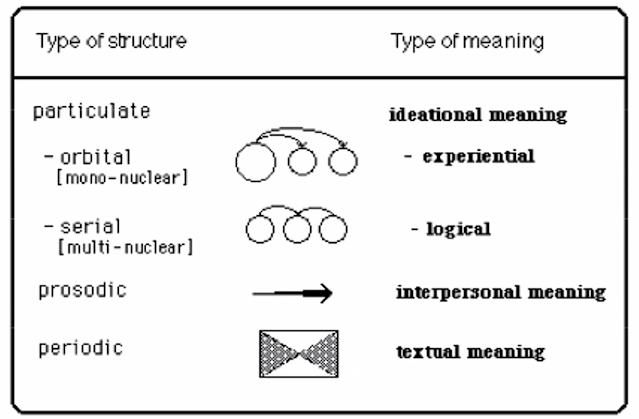
[2] To be clear, as demonstrated here and here, Martin's orbital vs serial distinction purports to model the structural distinction for the experiential vs logical metafunctions, but actually models the distinction between hypotaxis (nucleus vs satellite status) and parataxis (nuclei of the same status).

[3] To be clear, these are cohesive relations at the level of lexicogrammar, and Halliday & Matthiessen (2014) provides an updated interpretation.

[4] To be clear, by 1992, Lemke had already recanted his view that 'covariate' was a type of structure. Lemke (1988: 159):

My own 'covariate structure' (Lemke 1985), which includes Halliday's univariate type, is for the case of homogeneous relations of co-classed units, and should perhaps be called a 'structuring principle' rather than a kind of structure.

[5] To be clear, this remains a bare assertion until it is supported by evidence. The previous attempt to provide such evidence, Martin's seminar of 13/8/21, was demonstrated to be based on theoretical misunderstandings (see here).

[6] To be clear, Doran's work builds on Martin's misunderstanding of structure; see [2].

[7] To be clear, here Doran is modelling metalanguage (SFL Theory), not language, by essentially devising a metalinguistic system of features ("factors") that generates types of structure, as if metalanguage were language.

[8] To be clear, each of these factors is theoretically problematic.

Firstly, nuclearity corresponds to Martin's orbital structure, which purports to be a model of experiential structure, but is actually a model of logical hypotaxis (independent nucleus vs dependent satellites). That is, nuclearity misconstrues a multivariate structure as a univariate structure.

Secondly, linear interdependency is just interdependency. The word 'linear' is redundant, since all structures are linear. (For Halliday (1965), univariate structures are lineally recursive.) Linear interdependency corresponds to Martin's serial structure, which purports to be a model of the univariate structure of the logical metafunction, but is actually just a model of one of its dimensions: parataxis (multiple nuclei of the same status).

Thirdly, in SFL Theory, iteration describes the type of structure favoured by the logical metafunction (Halliday (1994: 36). The purpose of introducing Halliday's term here is to provide the possibility of 'iterative nuclearity' and 'non-iterative linear interdependency'; see [9].

To summarise, Doran's three factors actually concern:

  • hypotactic interdependency
  • paratactic interdependency
  • interdependency in general.

[9] To be clear, this "wider set of structures" includes iterative multivariate structures and non-iterative univariate structures (subjacency duplexes), neither of which withstands close scrutiny, as demonstrated here.

[10] To be clear, these phenomena include structure markers misconstrued as units in unit complexes, as in Martin's notion of a subjacency duplex.


Postscript:

The theoretical misunderstandings in this seminar turned out to be so complicated, that the paper is now being examined, slide by slide, here.

Saturday, 21 August 2021

One Of The Problems With Martin's Model Of Structure Types

Martin (1996) characterises metafunctional structures as follows:


However, Martin's structural distinction between experiential and logical meaning actually construes the distinction between unequal status (of nucleus vs satellite) and equal status (of multiple nuclei). That is, Martin's structure typology misconstrues the metafunctional distinction between experiential and logical as the logical distinction between hypotaxis and parataxis. If using Martin's model has led to confusion, this is one possible reason.

Sunday, 15 August 2021

Some Problems With Martin's Notion Of A 'Subjacency Duplex Structure'

Construing entities: types of structure
J. R. Martin

In this talk I address some issues arising from recent SFL work on language description, focusing on types of structure. In particular I will look at SFG's traditional distinction between multivariate and univariate structures and their association with non-recursive and recursive systems respectively (Halliday 1981, 1979). Drawing on descriptions of nominal group structure (in English, Tagalog, Spanish and Korean), I'll suggest that the association of multivariate structure with non-recursive systems and univariate structure with recursive systems needs to be relaxed. Doing so makes room for recognition of non-iterative dependency structure, which I'll refer to as subjacency structure (first foregrounded as duplexes in Rose's work on Pitjantjatjara; 2001) – a structure which can be usefully applied to the analysis of what are often fudged as 'structure markers' in SFG descriptions (i.e. adpositions and linkers).
Halliday, M A K 1981 (1965) Types of Structure. M A K Halliday & J R Martin [Eds.] Readings in Systemic Linguistics. London: Batsford. 29-41.

Halliday, M A K 1979 Modes of meaning and modes of expression: types of grammatical structure, and their determination by different semantic functions. D J Allerton, E Carney, D Holcroft [Eds] Function and Context in Linguistics Analysis: essays offers to William Haas. Cambridge: Cambridge University Press. 57-79

Rose, D 2001 The Western Desert code: an Australian cryptogrammar. Canberra: Pacific Linguistics.


Blogger Comments:

[1] To be clear, the notion of 'entity' in semantics is from Halliday & Matthiessen (1999: 172):
The nominal group, as we have seen, construes an entity — something that could function directly as a participant.
[2] To be clear, on the one hand, Martin takes Halliday (1965) as his point of departure rather than more recent publications. On the other hand, it is simply not true that Halliday (1965) equates the univariate/multivariate distinction with the recursive/non-recursive distinction. Halliday associates univariate structures with lineal recursion and multivariate structures with both cyclical recursion and non-recursion. Halliday (1981 [1965]: 45):
[3] To be clear, the term 'subjacency' is from Chomsky (1973), and the term 'duplex' is from Matthiessen (1995: 161) and simply means a univariate complex of two units. In his talk, Martin attributed 'duplex' to Rose, instead of Matthiessen, and falsely claimed that it occurs all through Rose's thesis, whereas, in fact, it only occurs 4 times (pp367-8, 400), and is only applied to verbal group complexes.

More importantly, Martin's notion of a 'subjacency duplex' structure rests on the claim that it is 'non-iterative' — meaning that the structure cannot be further modified through lineal recursion. The final example that Martin used to illustrate this was:


To be clear, the reason why this 'subjacency duplex' cannot be further modified is that it is not a duplex. That is, it is not a 2-unit complex: it is neither a nominal group complex nor a 'clitic complex', and the clitic neither modifies (subcategorises) the nominal group — see Halliday & Matthiessen (2014: 389) — nor hypotactically expands the nominal group in terms of elaboration, extension, or enhancement.

Monday, 9 August 2021

Halliday (1979) On Logical Structure As Recursive

Halliday (2002 [1979]: 212, 213, 215):
In the logical mode, reality is represented in more abstract terms, in the form of abstract relations which are independent of and make no reference to things. …
Since we are claiming these structural manifestations are only tendencies, such an argument is only tenable on the grounds that the type of structure that is generated by the logical component is in fact significantly different from all the other three. The principle is easy to state: logical structures are recursive. …
True recursion arises when there is a recursive option in the network, of the form shown in Figure 14, where A:x,y,z… n is any system and B is the option ‘stop or go round again’. This I have called “linear recursion”; it generates lineally recursive structures of the form a₁ + a₂ + a₃ + . . . (not necessarily sequential):
… Logical structures are different in kind from all the other three. In the terms of systemic theory, where the other types of structure – particulate (elemental), prosodic and periodic – generate simplexes (clauses, groups, words, information units), logical structures generate complexes (clause complexes, group complexes, etc.) (Huddleston 1965). … While the point of origin of a non-recursive structure is a particular rank – each one is a structure “of” the clause, or of the group, etc. – recursive structures are in principle rank-free: coordination, apposition, subcategorisation are possible at all ranks.


Postscript:

In his seminar paper (13/8/21) on 'construing entities', Martin claimed that there are no recursive networks anywhere in the SFL literature. The network above occurs in one of the references he provided.

Saturday, 24 November 2018

Today's 'Typology Forum' Paper By David Rose

The textual metafunction: making matter mean

David Rose
University of Sydney
The textual metafunction is sometimes presented as if it were an afterthought, there merely to organise interpersonal and ideational meanings into convenient structures of clause and text. But in the first stages of language, and in much of everyday discourse, it is the primary means of turning the world into meaning, with exophoric reference to the shared sensations of me and you, this and that, here and there. Once the world gets classified, and configured into clauses, and strung out into texts, the same resources used to indicate the world around us are re-deployed to indicate the semiotic world within a text. Where once there were only signs, now meanings come in messages, each of which must be sensible in the unfolding world of the text, and manage listeners’ attention to the information they present. 
Textual typological studies might start from observing these three general functions: introducing and tracking meanings through a text, or phoricity, contextualising messages, or thematicity, and managing information prominence, or newsworthiness. Resources for realising these functions are prototypically distributed between language strata: phoricity in the reference chains of discourse, thematicity in segmental structures of clauses, and newsworthiness in periodic structures of tone groups. But while they are in principle independently variable, both the functions and their realisations interact with each other, and variations in textual functions proliferate as a result. Perhaps also as a consequence of these interactions, their realisations come to vary across languages and registers. 
This paper will make some general observations about interactions between phoricity and thematicity and between thematicity and newsworthiness, and will exemplify variations in these interactions between languages. In the process, it will also illustrate textual variations in register, from dialogue to monologue, and from accompanying to constituting fields.


Blogger Comments:

[1] Rose's negative appraisal — implied by 'afterthought' and 'merely' (counter-expectancy: limiting) — of an unsourced characterisation of the textual metafunction is unjustified. Halliday & Matthiessen (1999: 398):
The textual metafunction is second-order in the sense that it is concerned with semiotic reality: that is, reality in the form of meaning. This dimension of reality is itself constructed by other two metafunctions: the ideational which construes a natural reality, and the interpersonal, which enacts an intersubjective reality. The function of the textual metafunction is thus an enabling one with respect to the rest; it takes over the semiotic resources brought into being by the other two metafunctions and as it were operationalises them.
[2] Here Rose confuses the ideational and textual metafunctions.  It is the ideational metafunction that construes experience as meaning ("turns the world into meaning").

[3] As Halliday & Matthiessen (1999: 530) point out, the textual metafunction only operationalises the resources already created by the other metafunctions:
Reference is a way of referring to things that are already semiotically accessible: either actually, in the text, or potentially, in the context of situation.
[4] To be clear, "classifying the world" is construing experience as ideational meaning.

[5] To be clear, it is experiential options that are "configured into clauses", and "configured" takes a structural (syntagmatic) rather than systemic (paradigmatic) perspective on the clause.

[6] To be clear, it is meaning that is "strung out into texts", through the process of instantiation during logogenesis.

[7] To be clear, these resources are ideational potential, construed of experience, and on the SFL model, they do not "indicate" the world, since there are no meanings outside semiotic systems that can be "indicated".

[8] To be clear, in theoretical terms, this "redeployment" is the process of instantiation during logogenesis.

[9] To be clear, in theoretical terms, "indicate" here refers to the logical projection of second-order meaning.

[10] To be clear, in SFL terms, this is the semogenic distinction between protolanguage ("signs") and language ("messages"), though there is no reason to think that this is Rose's meaning.

[11] Here Rose switches to promoting Martin's work on textual systems, as if the preceding paragraph leads naturally to them, and as if they address the (confused) issues he has raised.

[12] This misrepresents the model in Martin (1992).  The meanings that are introduced and tracked are participants, and the system for doing so is termed IDENTIFICATION, not phoricity.  Martin's model is Halliday & Hasan's (1976) model of cohesive reference, misunderstood, rebranded and relocated from lexicogrammar to discourse semantics (evidence here).  Essentially, Martin confuses
  • textual reference with reference in the sense of ideational denotation, like his source Du Bois (1980),
  • interpersonal deixis of nominal group structure with non-structural textual reference, and, as a result,
  • nominal groups realising participants with reference items,
which is why the experiential feature 'participant' is presented (Martin 1992: 325) as the unit and entry condition of this textual discourse semantic system.

[13] These refer to Martin's (1992) reworkings of Halliday's THEME and INFORMATION, which confuse linguistic theory (Theme, New) with writing pedagogy, namely:
  • introductory paragraph, rebranded as Macro-Theme, 
  • topic sentence, rebranded as Hyper-Theme (misunderstood from Daneš (1974)), 
  • paragraph summary, rebranded as Hyper-New, and 
  • text summary, rebranded as Macro-New.
Evidence here.

[14] In SFL theory, these are all systems of the lexicogrammatical stratum.

[15] In SFL theory, reference chains represent (non-structural) cohesive relations within the lexicogrammar.

[16] The claim that thematicity is "distributed" in segmental structures is not only inconsistent with SFL theory, but also with Martin (1992), and most notably with Martin & Rose (2007), where such structures are modelled as waves in a chapter titled Periodicity.

[17] This follows Martin (1992: 384) in confusing the content plane (INFORMATION is a lexicogrammatical system) with the expression plane (the tone group is a rank unit of the phonological stratum).

[18] The notion of "interaction" between strata — different levels of symbolic abstraction — repeats Martin's (1992: 488) misunderstanding of the dimensions of the SFL theoretical architecture as modules.  See the explanatory critiques here.

[19] To be clear, in SFL theory, because 'register' refers to a functional variety of language, it is modelled as a point on the cline of instantiation.  Here Rose follows Martin (1992) in misconstruing register as a stratum of context, the culture as semiotic system.  See the critiques here.

[20] To be clear, in SFL theory, the dialogue vs monologue distinction is one of MODE, a system of context (culture), not register (language).

[21] The notion of 'constituting field' derives from Martin (1992: 185, 193) where it applies to activity sequences, which are modelled in that work as context (field), misconstrued as register, but in Martin & Rose (2007: 100-3) as discourse semantic.  To complicate matters further, Rose, like Martin, confuses the ideational semantics (that realises a field) with field (misconstrued as register).

Moreover, in presenting this distinction as a textual distinction at the level of context, it invites confusion with Hasan's (1985/9: 58) feature opposition of ancillary vs constitutive LANGUAGE RÔLE in her model of MODE, the textual system at the level of context (culture), not register (language):
First, there is the question of the LANGUAGE RÔLE — whether it is constitutive or ancillary. These categories should not be seen as sharply distinct but rather as two end-points of a continuum.

Tuesday, 19 June 2018

Lemke On Covariate "Structure"

Lemke (1988: 159) reinterpreted his 'covariate structure' as a structuring principle, rather than a kind of structure:
My own 'covariate structure' (Lemke 1985), which includes Halliday's univariate type, is for the case of homogeneous relations of co-classed units, and should perhaps be called a 'structuring principle' rather than a kind of structure. 

Thursday, 26 April 2018

Martin's Rebranding Of Halliday's 'Extended Numerative' As "Focus"

From Deploying Functional Grammar (Martin et al 2010: 169):
However, there is one type of structure where the two types of structure [logical and experiential] are out of phase with one another … .  This happens when the Head is a noun that does not represent a thing in its own right but rather an elaboration or extension of another thing, as in the side of the house, two metres of fabric, another cup of coffee. … we'll suggest an analysis here that treats these structures as having an embedded nominal group with the multivariate function Focus …


two
metres
of
fabric
multivariate
Focus
Thing
univariate
β
Head
β


Blogger Comments:

To be clear, this is merely a rebranding of Halliday's 'complex Numerative' (IFG2: 195-6) or 'extended Numerative' (IFG3: 332-5; IFG4: 394-6) as "Focus".  The analysis above is merely a rebranding of:


two
metres
of
fabric
experiential
extended Numerative: quantum
Thing
logical
Premodifier
Head
Postmodifier

No argument is provided in support of the change of terminology, which fails to acknowledge its Numerative function, and the term itself is textual, not experiential, in orientation, and is already in use in SFL theory for the focus of New information.

For other examples of Martin rebranding other people's ideas, see here.