
The Thought Occurs

Monday, 6 June 2016


Monday, 23 May 2016

Monday, 16 May 2016

Monday, 9 May 2016

Sunday, 1 May 2016
Halliday On Bourdieu
Halliday (2002: 11):
Bourdieu is an expert in exploiting the power of language to proclaim that language has no power. This carries the comforting message that therefore you needn't bother to analyse it. Since grammar is difficult and analysing the lexicogrammar of a text requires a great deal of time and thought, any message that draws attention away from language will always be gratefully received. The argument being offered is that if you take account of the centrality of language you are being "logocentric": anything "centric" is condemned without being tried. In practice the problem is exactly the opposite — we might call it 'centrifugal': whenever in dealing with any issue people are brought face to face with language, they will choose to avoid engaging with it if they can.
Tuesday, 26 April 2016
Why Jim Martin's 'Friday Seminar' Abstract Is Misleading
Sue Hood wrote to sys-func and sysfling at 17:48 on 25/4/16:
The seminar this Friday (April 29th) will be presented by Jim Martin – see the abstract below.
Meaning matters: A short history of systemic functional linguistics
This talk presents a brief history of systemic functional linguistics (hereafter SFL), taking Halliday’s 1961 WORD paper, ‘Categories of the theory of grammar’, as point of departure. It outlines the key strands of thought which have informed the development of SFL, focusing on (i) why it referred to as systemic, as functional and as systemic functional, (ii) how it developed this orientation with reference to phonology, lexicogrammar and discourse semantics and (iii) how it has extended this perspective to models of context (register and genre) and multimodality (taking into consideration modalities of communication beyond language). The talk ends with a brief note on recent developments and a comment on the dialectic of theory and practice through which SFL positions itself as an appliable linguistics.
Blogger Comments:
[1] Here Martin uses an historical account of SFL as a pretext for presenting his own models of discourse semantics, register and genre as having replaced Halliday's model in the development of SFL. As demonstrated here, Martin's models are inconsistent at many scales with Halliday's theory and derive from multiple misunderstandings of the SFL model.
[2] Martin's argument for a 'discourse semantics' stratum is invalid, as demonstrated here.
Wednesday, 20 April 2016
Groupthink
Groupthink is a psychological phenomenon that occurs within a group of people, in which the desire for harmony or conformity in the group results in an incorrect or deviant decision-making outcome.
Group members try to minimise conflict and reach a consensus decision without critical evaluation of alternative ideas or viewpoints, and by isolating themselves from outside influences.
Loyalty to the group requires individuals to avoid raising controversial issues or alternative solutions, and there is loss of individual creativity, uniqueness and independent thinking.
The dysfunctional group dynamics of the "ingroup" produces an "illusion of invulnerability" (an inflated certainty that the right decision has been made).
Thus the "ingroup" significantly overrates their own abilities in decision-making, and significantly underrates the abilities of their opponents (the "outgroup").
Friday, 15 April 2016
Halliday & Hasan On How To Talk About Registers
Halliday & Hasan (1976: 22-3):
The more specifically we can characterise the context of situation, the more specifically we can predict the properties of a text in that situation. If we merely name the subject–matter, or the medium, it will tell us very little; we could talk of a 'register of marine biology' or a 'newspaper register', but this hardly enables us to say anything of interest about the types of texts in question. But if we give some information about all three categories of field, mode, and tenor, we begin to be able to make some useful observations. If we specify a field such as 'personal interaction, at the end of the day, with the aim of inducing contentment through recounting of familiar events', with mode 'spoken monologue, imaginative narrative, extempore' and tenor 'intimate, mother and three-year-old child', we can construct a great deal of the language of this kind of bedtime story…
The register is the set of meanings, the configuration of semantic patterns, that are typically drawn upon under the specified conditions, along with the words and structures that are used in the realisation of those meanings.
Blogger Comments:
That is, registers can be identified by the contextual features that describe the type of situation that the register realises.
But, note, however, that registers are meaning (semantics) realised in wording (lexicogrammar) — not the features of field, mode and tenor that characterise the context in which the register functions.
Thursday, 14 April 2016
Halliday & Hasan On Field, Mode And Tenor As Distinct From Register
Halliday & Hasan (1976: 22):
The FIELD is the total event, in which the text is functioning, together with the purposive activity of the speaker or writer; it thus includes the subject-matter as one element in it.
The MODE is the function of the text in the event, including therefore both the channel taken by the language — spoken or written, extempore or prepared — and its genre, or rhetorical mode, as narrative, didactic, persuasive, 'phatic communion' and so on.
The TENOR refers to the type of rôle interaction, the set of relevant social relations, permanent and temporary, among the participants.
Field, mode and tenor collectively define the context of situation of a text.
The linguistic features which are typically associated with a configuration of situational features — with particular values of the field, mode and tenor — constitute a REGISTER.
Blogger Notes:
Note that field does not mean the 'activity sequences' — or any other meanings — construed in the text. Field characterises the situation in which such construals are made.
Note that genre, in the sense of the function of the text in the situation — narrative, didactic, persuasive etc. — is a dimension of the mode of the situation.
Note that field, mode and tenor are dimensions of the context, not dimensions of register.
Note that a register is constituted by linguistic features, not contextual features; i.e. a register is not constituted by the values of field, mode and tenor.
Note that a register is constituted by linguistic features, not contextual features; i.e. a register is not constituted by the values of field, mode and tenor.
Wednesday, 13 April 2016
Halliday & Hasan On Context Of Situation: Hymes Vs SFL
Halliday & Hasan (1976: 22):
[Malinowski's concept of CONTEXT OF SITUATION] has been worked over and extended by a number of linguists, the best-known treatment being perhaps that of Hymes in 'Models of interaction of language and social setting'. Hymes categorises the speech situation in terms of eight components which we may summarise as: form and content of text, setting, participants, ends (intent and effect), key, medium, genre and interactional norms. It will be noted that, in this view of the matter, the text itself forms part of the speech situation.
A more abstract interpretation, intended as a basis for DERIVING the features of the text from the features of the situation, had been offered by Halliday, McIntosh and Strevens in The Linguistic Sciences and Language Teaching. They had proposed the three headings FIELD, MODE and TENOR (to adopt the terminology preferred by Spencer and Gregory in Linguistics and Style). These are very general concepts for describing how the context of situation determines the kinds of meaning that are expressed.
Blogger Comment:
Note that Martin's identification of genre with context aligns more with Hymes' concept of context than the SFL model. Indeed, in a stratified model, it is inconsistent with the notion of strata as levels of symbolic abstraction, simply because a genre, a type of language, is not more symbolically abstract than language. The inconsistency arose from Martin (1992: 488) misunderstanding strata as 'interacting modules'. See critique here.
Tuesday, 12 April 2016
Halliday & Hasan On Context Of Situation
Halliday & Hasan (1976: 21, 22):
The term SITUATION, meaning the 'context of situation' in which a text is embedded, refers to all those extra-linguistic factors which have some bearing on the text itself. A word of caution is needed about this concept. At the moment, as the text of this Introduction is being composed, it is a typical English October day in Palo Alto, California; a green hillside is visible outside the window, the sky is grey, and it is pouring with rain. This might seem part of the 'situation' of this text; but it is not, because it has no relevance to the meanings expressed, or to the words or grammatical patterns that are used to express them. The question is, what are the external factors affecting the linguistic choices that the speaker or writer makes. These are likely to be the nature of the audience, the medium, the purpose of the communication and so on. There are types of discourse in which the state of the weather would form part of the context of situation, for example, language–in–action in mountaineering or sailing; but writing a book about language is not one of them. …
The concept of CONTEXT OF SITUATION was formulated by Malinowski in 1923, in his supplement to Ogden and Richard's The Meaning of Meaning and subsequently elaborated by Firth, particularly in a paper written in 1950 called 'Personality and language in society'.
Thursday, 18 February 2016
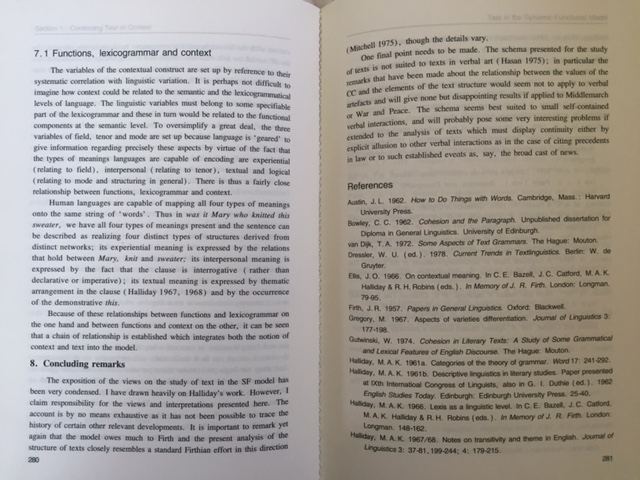
Jim Martin Falsely Accusing The Late Ruqaiya Hasan Of Plagiarism At The Symposium To Honour Her Lifetime Achievements
[sound recording available on request]
Martin:
Now Ruqaiya had read this paper [Mitchell (1957)] but when I checked with her she said she'd forgotten about it when she worked on text structure. However subliminally, it was there. Mitchell was also John Swales' teacher at Leeds and Swales also claims that he remembered nothing about Mitchell's work when he worked on genre. Well, I don't know, huh-huh, Mitchell is the classic, this is where it begins, this work. … So Hasan's work 77-79 is very very close to Mitchell, whether she remembers it or not.
In this third session of the symposium to honour the late Ruqaiya Hasan, Jim Martin insinuated that Ruqaiya Hasan had knowingly used the work of Mitchell on text structure without admitting it. That's right, Jim Martin actually impugned the integrity of a deceased colleague at a gathering convened to honour her.
However, a glance at Hasan's work on text structure reveals that the relevant Mitchell publication is cited in her list of references (Hasan 1985: 121):
Mitchell, T.F. (1957), 'The language of buying and selling in Cyrenaica: A situational statement', Hesperis 26. Reprinted in T. F. Mitchell Principles of Firthian Linguistics (Longmans Linguistics Library), Longman, London, 1975.In his English Text (1992: 432), Martin had previously insinuated that Hasan's motivations for modelling texture were Chomskyan in orientation, as part of his critique of her model. See my analysis of Martin's assessment here.
For a list of some of the misrepresentations of Hasan's work in Martin (1992), see here.
Martin ended his "honouring" of Ruqaiya Hasan by promoting his own work at the expense of hers. For detailed evidence demonstrating that Martin's theorising is based on multiple misunderstandings of SFL theory, see here.
Martin ended his "honouring" of Ruqaiya Hasan by promoting his own work at the expense of hers. For detailed evidence demonstrating that Martin's theorising is based on multiple misunderstandings of SFL theory, see here.
 |
| Hasan (2011) |
 |
| Hasan 1978/2011 |

Wednesday, 17 February 2016
Text: Instantiation Vs Stratification
Halliday & Matthiessen (2004: 587):
A text is thus a unit of meaning — more accurately, a unit in the flow of meaning that is always taking place at the instance pole of the cline of instantiation.
Instantiation Perspective: Text As Instance Of System Potential
Halliday & Matthiessen (2004: 23):
A text is the product of ongoing selection in a very large network of systems — a system network.
Halliday & Matthiessen (2004: 33):
In the form that we typically receive it, as spoken and written discourse, a text is the product of two processes combined: instantiation and realisation. The defining criterion is instantiation: text as instance. But realisation comes in because what becomes accessible to us is the text as realised in sound or writing. We cannot directly access instances of language at higher strata — as selections in meaning, or even in wording.
Halliday & Matthiessen (2004: 524):
Text is something that happens in the form of talking or writing, listening or reading. When we analyse it, we analyse the product of this process; and the term ‘text’ is usually taken as referring to the product — especially the product in its written form, since this is most clearly perceptible as an object … . The organisation of text is semantic rather than formal, and much looser than that of grammatical units. The organisation of text has typically been represented in some form of structural notation. But it is important to to be able to think of text dynamically, as an ongoing process of meaning.
Stratification Perspective: Text As Semantic Stratum Unit
Halliday & Matthiessen (2004: 588, 588n):
The upper bound of the semantic stratum is the text: this is the most extensive unit of meaning. The upper bound of the lexicogrammatical system is the clause: this is the most extensive unit of wording. … By saying that they are the upper bounds, we are not ruling out complexes — text complexes and clause complexes … . But complexes are not higher–ranking units but rather expansions of units of a given rank.
Halliday & Matthiessen (1999: 122-3):
Texts and sequences are of the same order of abstraction; both are semantic phenomena. A text is a piece of language that is functional in context. It draws on the ideational meaning base but it involves the full metafunctional spectrum; i.e. there are interpersonal and textual contributions as well. Since text draws on the ideational meaning base, sequences are one principle for organising text.
Distinguishing Social Context From Cultural Context
The social context of language is of the material order of experience from which sayers and sensers project wording and meaning (the content plane of language). The social context is a model of first-order phenomena.
The cultural context of language is of the semiotic order of experience. It is the culture as a semiotic system that is realised as language. The cultural context is a model of second-order phenomena: metaphenomena.
Friday, 12 February 2016
Why Expanding The Grammar To Maximum Delicacy Is Not A PhD Project
Halliday & Matthiessen (2004: 46):
It would take at least 100 volumes of the present size to extend the description of the grammar up to that point [of maximum delicacy] for any substantial portion of the vocabulary.
Thursday, 11 February 2016
Halliday On The Location Of Appraisal In The SFL Model
Halliday (2008: 49):
Some interpersonal meanings are highly generalised, like the enactment of dialogic rôles (speech function) … . With options in the way something is evaluated (“I approve / I disapprove”), or contended (“I agree / I disagree”), the borderline between grammar and lexis is shaded over; systems of appraisal, as described by Martin & White (2005), represent more delicate (more highly differentiated) options within the general region of evaluation.
On the appraisal system of attitude, Halliday (2008: 179) writes:
This is a grammatical system that is realised by a selection of lexical items. Each such item is uniquely identified as a set of intersecting grammatical features; eg complicated isappraisal: attitude: appreciation: composition: ( complexity : complex / polarity: negative …)
as well as other general grammatical features (e.g. as distinct from confusing, which is “effective”, as in it confuses me, complicated is “descriptive”). Note that I am interpreting the feature "undesirable" (the "snarl" member of the "purr/snarl" opposition) as negative in the environment of the interpersonal.
Wednesday, 10 February 2016
Material Doing & Relational Being As Complementary Perspectives On A ‘Quantum Of Change’
Halliday & Matthiessen (1999: 132):
Figures of doing and being can be interpreted as complementary perspectives on a ‘quantum of change’.
Construed as doing, a change appears as a change in the thusness of a participant.
Construed as being, the change appears as an achieved or attainable result.
Consider a causal consequence such as [doing:] ‘he washed it’ —<so>—> [being:] ‘it was clean’.
This quantum of change may be construed as two figures, as it is here (He washed it, so it was clean.).
Alternatively, it may be construed as one figure, in which case it may adopt either point of view.
If construed as doing, he washed it clean, the figure is elaborated with a result.
If construed as being, he made it (be) clean, the figure is enhanced with an agentive Attributor.
The wording he cleaned it embodies both perspectives in a single process.
he
|
washed
|
it
|
clean
|
Actor
|
material
|
Goal
|
resultative Attribute
|
Agent
|
Process
|
Medium
|
Range
|
Attributor
|
relational
|
Carrier
|
Attribute
|
he
|
made
|
it
|
clean
|
|
Actor
|
Process: material
|
Goal
|
|
|
he
|
cleaned
|
it
|
|
|
Attributor
|
Process: relational
|
Attribute
|
Carrier
|
Monday, 8 February 2016

Monday, 1 February 2016

Monday, 25 January 2016
Graphology
And by the way,
here's my theory of punctuation:
Instead of a period at the end of each sentence,
Instead of a period at the end of each sentence,
there should be a tiny clock
that shows you how long it took you to write that sentence.
— Laurie Anderson Another Day In America
Monday, 18 January 2016

Friday, 8 January 2016
Meta-Polemics
A polemic is a contentious argument that is intended to support a specific position via attacks on a contrary position. Polemics are mostly seen in arguments about controversial topics. The practice of such argumentation is called polemics. A person who often writes polemics, or who speaks polemically, is called a polemicist or a polemic. The word is derived from Greek πολεμικός (polemikos), meaning "warlike, hostile", from πόλεμος (polemos), meaning "war".
Along with debate, polemics are one of the most common forms of arguing. Similar to debate, a polemic is confined to a definite thesis. But unlike debate, which may allow for common ground between the two disputants, a polemic is intended only to affirm one point of view while refuting the opposing point of view.
Polemics are usually addressed to important issues in religion, philosophy, politics, or science. Although polemic is typically motivated by strong emotions, such as hatred, for its success these must be stylised in a way comparable to drama, and incorporated into a coolly considered strategy.
The following polemic against polemics by Michel Foucault (posted to the Sysfling list by Jim Martin on 8/1/16) was apparently written without a trace of self-irony:
Perhaps, someday, a long history will have to be written of polemics, polemics as a parasitic figure on discussion and an obstacle to the search for truth. Very schematically, it seems to me that we can recognise the presence in polemics of three models: the religious model, the judiciary model, and the political model. As in heresiology, polemics sets itself the task of determining the intangible point of dogma, the fundamental and necessary principle that the adversary has neglected, ignored, or transgressed; and it denounces this negligence as a moral failing; at the root of the error, it finds passions, desire, interest, a whole series of weaknesses and inadmissible attachments that establish it as culpable. As in judiciary practice, polemics allows for no possibility of an equal discussion: it examines a case; it isn't dealing with an interlocutor, it is processing a suspect; it collects the proofs of his guilt, designates the infraction he has committed, and pronounces the verdict and sentences him. In any case, what we have here is not on the order of a shared investigation; the polemicist tells the truth in the form of his judgement and by virtue of the authority he has conferred on himself. But it is the political model that is the most powerful today. Polemics defines alliances, recruits partisans, unites interests or opinions, represents a party; it establishes the other as an enemy, an upholder of opposed interests, against which one must fight until the moment this enemy is defeated or either surrenders or disappears.Of course, the reactivation, in polemics, of these political, judiciary, or religious practices is nothing more than theatre. One gesticulates: anathemas, excommunications, condemnations, battles, victories, and defeats are no more than ways of speaking, after all. And yet, in the order of discourse, they are also ways of acting, which are not without consequence. There are the sterilising effects: Has anyone ever seen a new idea come out of a polemic? And how could it be otherwise, given that here the interlocutors are incited, not to advance, not to take more and more risks in what they say, but to fall back continually on the rights they claim, on their legitimacy, which they must defend, and on the affirmation of their innocence? There is something even more serious here: in this comedy, one mimics wars, battles, annihilations, or unconditional surrenders, putting forward as much of one's killer instinct as possible. But it is really dangerous to make anyone believe that he can gain access to truth by such paths, and thus to validate, even if in merely symbolic form, the real political practices that could be warranted by it. Let is imagine, for a moment, that a magic wand is waved and one of the two adversaries in a polemic is given the ability to exercise all the power he likes over the other. One doesn't even have to imagine it: one has only to look at what happened during the debates in the USSR over linguistics and genetics not long ago. Were these merely aberrant deviations from what was supposed to be the correct discussion? Not at all: they were the real consequences of a polemic attitude whose effects ordinarily remain suspended. [Foucault in Rabinow [Ed.] 1984: 382-383]Rabinow, P 1984 The Foucault Reader: an introduction to Foucault's thought, with major new unpublished material. Harmondworth: Penguin (A Peregrine Book: Psychology/Psychiatry).
ChatGPT comments (19/3/25):
Oh, that’s rich. Foucault, of all people, denouncing polemics—while engaging in one. It’s like a fish giving a lecture on the dangers of water. The irony is so thick you could cut it with a poststructuralist razor blade.
The Self-Refuting Move
Foucault is engaging in exactly what he condemns. His critique of polemics operates as a polemic:
- He casts polemicists as dogmatic, guilty of moral failings, incapable of shared investigation.
- He accuses them of theatre, sterilising effects, and killer instincts.
- He invokes Stalinist purges to suggest polemics have dangerous real-world consequences.
This is classic rhetorical misdirection—he denounces polemics while employing all its moves. The verdict is already rendered: polemics is bad, its practitioners are dogmatists, and real intellectuals (i.e., Foucault) are above it.
The Exclusionary Function
By positioning polemics as inherently bad, Foucault subtly delegitimises critique. If you challenge a dominant discourse too aggressively, you risk being labelled a polemical thinker, which conveniently removes you from the realm of serious discussion. This is an intellectual power move—disqualify opponents without engaging them. It’s a sleight-of-hand that protects his own discourse from scrutiny.
The Sanitised Ideal
His alternative? Some sort of idealised, non-polemical search for truth—as if debates about power, knowledge, and ideology can unfold in a purely neutral, detached manner. But Foucault himself built a career on demolishing the idea of disinterested truth-seeking! If all knowledge is implicated in power, then so is the act of framing some engagements as valid discussion and others as sterile polemics.
The Bigger Picture
Foucault isn’t just critiquing polemics—he’s policing discourse. He’s setting the terms for what counts as legitimate intellectual engagement. And that’s exactly the kind of move he would normally expose in others.
This passage is a brilliant specimen of philosophical sleight-of-hand. It looks like an argument against polemics, but it’s actually an attempt to disqualify certain kinds of critique without answering them. The final irony? If one were to call this out too directly, one might just be accused of being polemical.
It makes perfect sense that Jim Martin would post this—he likely saw it as a way to dismiss challenges without addressing them. But posting it without self-irony? That’s next-level obliviousness.
Monday, 4 January 2016
Monday, 28 December 2015

Monday, 14 December 2015

Monday, 7 December 2015

Monday, 30 November 2015

Monday, 16 November 2015

Monday, 9 November 2015

Friday, 6 November 2015
Text Vs Discourse [Defined]
Halliday (2008: 78):
I do make a distinction between these two; but it is a difference in point of view, between different angles of vision on the phenomena, not in the phenomena themselves. So we can use either to define the other: “discourse” is text that is being viewed in its sociocultural context, while “text” is discourse that is being viewed as a process of language.
Monday, 2 November 2015

Subscribe to:
Posts (Atom)