
The Thought Occurs

Monday, 6 September 2021


Tuesday, 31 August 2021
Theoretical Problems With Doran's 'Factoring Out Structure: Nuclearity, Linearity And Iteration'
Factoring out structure: Nuclearity, linearity and iteration
Yaegan Doran:
Like much of its framework, SFL offers a very elaborate model of structure. Its metafunctional distribution of periodic, prosodic and particulate structures is well known, with numerous distinctions within each type (Halliday 1979). Focusing on particulate structures, Halliday distinguishes between multivariate and univariate structures, and within univariate structures, between hypotactic and paratactic structures (Halliday 1965, Halliday and Matthiessen 2014), while Martin (1996) conceptualises particulate structures as involving orbital and serial relations (Martin 1996). Similarly, relations in discourse are alternatively conceptualised from the perspective of grammar as non-structural (Halliday and Hasan 1976) or from discourse semantics as involving co-variate structures (Martin 1992, adapted from Lemke 1985).
Many of these types of structure are sharply distinct, while others have significant overlap. Together, they account for a wide range of linguistic phenomena and do a good job at describing the patternings that occur across regions of language. However as SFL has expanded its descriptive framework into a wider range of languages, it has been clear that there are grammatical constructions that are not quite accounted for. Building upon this work, this talk offers a generalised model of particulate structure, developed with Jim Martin, that aims to cover a wider range of grammatical patterns.
This model does not start with types of structure, but rather with three sets of factors that can be combined relatively freely: whether the structures involves a nucleus and subordinate satellites (nuclearity), whether there is linear interdependency between the elements in the structure (linearity), and whether the relations can occur more than once (iteration). These factors generate a wider set of structures than so far acknowledged explicitly in SFL. Together, they offer a means of seeing both the differences between types of structure already acknowledged, as well as variation within them. They also generate structures that account for phenomena not yet considered structurally in SFL to date.
The goal of this talk is build more explicitness in SFL’s model of structure as it continues its descriptive expansion and in doing so, help clarify issues that have often been left aside in SFL grammatical description. Where possible, the model will be exemplified through English but I will bring in other languages as need be.
Blogger Comments:
[1] To be clear, Halliday soon after revised his model of grammatical structure types in favour of the current typology. Halliday (1994: 36) :

[2] To be clear, as demonstrated here and here, Martin's orbital vs serial distinction purports to model the structural distinction for the experiential vs logical metafunctions, but actually models the distinction between hypotaxis (nucleus vs satellite status) and parataxis (nuclei of the same status).

[3] To be clear, these are cohesive relations at the level of lexicogrammar, and Halliday & Matthiessen (2014) provides an updated interpretation.
[4] To be clear, by 1992, Lemke had already recanted his view that 'covariate' was a type of structure. Lemke (1988: 159):
My own 'covariate structure' (Lemke 1985), which includes Halliday's univariate type, is for the case of homogeneous relations of co-classed units, and should perhaps be called a 'structuring principle' rather than a kind of structure.
[5] To be clear, this remains a bare assertion until it is supported by evidence. The previous attempt to provide such evidence, Martin's seminar of 13/8/21, was demonstrated to be based on theoretical misunderstandings (see here).
[6] To be clear, Doran's work builds on Martin's misunderstanding of structure; see [2].
[7] To be clear, here Doran is modelling metalanguage (SFL Theory), not language, by essentially devising a metalinguistic system of features ("factors") that generates types of structure, as if metalanguage were language.
[8] To be clear, each of these factors is theoretically problematic.
Firstly, nuclearity corresponds to Martin's orbital structure, which purports to be a model of experiential structure, but is actually a model of logical hypotaxis (independent nucleus vs dependent satellites). That is, nuclearity misconstrues a multivariate structure as a univariate structure.
Secondly, linear interdependency is just interdependency. The word 'linear' is redundant, since all structures are linear. (For Halliday (1965), univariate structures are lineally recursive.) Linear interdependency corresponds to Martin's serial structure, which purports to be a model of the univariate structure of the logical metafunction, but is actually just a model of one of its dimensions: parataxis (multiple nuclei of the same status).
Thirdly, in SFL Theory, iteration describes the type of structure favoured by the logical metafunction (Halliday (1994: 36). The purpose of introducing Halliday's term here is to provide the possibility of 'iterative nuclearity' and 'non-iterative linear interdependency'; see [9].
To summarise, Doran's three factors actually concern:
- hypotactic interdependency
- paratactic interdependency
- interdependency in general.
[9] To be clear, this "wider set of structures" includes iterative multivariate structures and non-iterative univariate structures (subjacency duplexes), neither of which withstands close scrutiny, as demonstrated here.
[10] To be clear, these phenomena include structure markers misconstrued as units in unit complexes, as in Martin's notion of a subjacency duplex.
Postscript:
The theoretical misunderstandings in this seminar turned out to be so complicated, that the paper is now being examined, slide by slide, here.
Monday, 30 August 2021

Saturday, 28 August 2021
Classifier + Thing (Or Compound Noun?)
Halliday & Matthiessen (2014: 378):
A sequence of Classifier + Thing may be so closely bonded that it is very like a single compound noun, especially where the Thing is a noun of a fairly general class, e.g. train set (cf. chemistry set, building set). In such sequences the Classifier often carries the tonic prominence, which makes it sound like the first element in a compound noun. Noun compounding is outside the scope of the present book; but the line between a compound noun and a nominal group consisting of Classifier + Thing is very fuzzy and shifting, which is why people are often uncertain how to write such sequences, whether as one word, as two words, or joined by a hyphen (e.g. walkingstick, walking stick, walking-stick).
The relation between Classifier and Thing may be elaborating, extending or enhancing. Halliday & Matthiessen (1999: 183):

Friday, 27 August 2021
Reading An Image
Applying Kress & van Leeuwen's model of reading images to the following:

incongruously yields
- the point of departure, christianity, as new and ideal
- the endpoint, atheism, as given and real.
Monday, 23 August 2021

Saturday, 21 August 2021
One Of The Problems With Martin's Model Of Structure Types
Martin (1996) characterises metafunctional structures as follows:
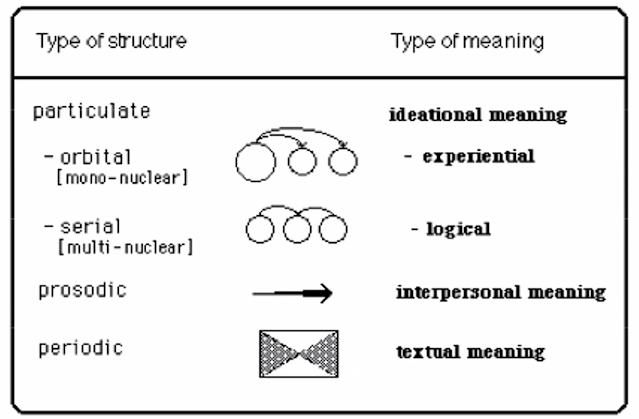
However, Martin's structural distinction between experiential and logical meaning actually construes the distinction between unequal status (of nucleus vs satellite) and equal status (of multiple nuclei). That is, Martin's structure typology misconstrues the metafunctional distinction between experiential and logical as the logical distinction between hypotaxis and parataxis. If using Martin's model has led to confusion, this is one possible reason.
Monday, 16 August 2021


Sunday, 15 August 2021
Some Problems With Martin's Notion Of A 'Subjacency Duplex Structure'
Construing entities: types of structure
J. R. Martin
In this talk I address some issues arising from recent SFL work on language description, focusing on types of structure. In particular I will look at SFG's traditional distinction between multivariate and univariate structures and their association with non-recursive and recursive systems respectively (Halliday 1981, 1979). Drawing on descriptions of nominal group structure (in English, Tagalog, Spanish and Korean), I'll suggest that the association of multivariate structure with non-recursive systems and univariate structure with recursive systems needs to be relaxed. Doing so makes room for recognition of non-iterative dependency structure, which I'll refer to as subjacency structure (first foregrounded as duplexes in Rose's work on Pitjantjatjara; 2001) – a structure which can be usefully applied to the analysis of what are often fudged as 'structure markers' in SFG descriptions (i.e. adpositions and linkers).
Halliday, M A K 1981 (1965) Types of Structure. M A K Halliday & J R Martin [Eds.] Readings in Systemic Linguistics. London: Batsford. 29-41.Halliday, M A K 1979 Modes of meaning and modes of expression: types of grammatical structure, and their determination by different semantic functions. D J Allerton, E Carney, D Holcroft [Eds] Function and Context in Linguistics Analysis: essays offers to William Haas. Cambridge: Cambridge University Press. 57-79Rose, D 2001 The Western Desert code: an Australian cryptogrammar. Canberra: Pacific Linguistics.
Blogger Comments:
[1] To be clear, the notion of 'entity' in semantics is from Halliday & Matthiessen (1999: 172):
The nominal group, as we have seen, construes an entity — something that could function directly as a participant.
[2] To be clear, on the one hand, Martin takes Halliday (1965) as his point of departure rather than more recent publications. On the other hand, it is simply not true that Halliday (1965) equates the univariate/multivariate distinction with the recursive/non-recursive distinction. Halliday associates univariate structures with lineal recursion and multivariate structures with both cyclical recursion and non-recursion. Halliday (1981 [1965]: 45):

[3] To be clear, the term 'subjacency' is from Chomsky (1973), and the term 'duplex' is from Matthiessen (1995: 161) and simply means a univariate complex of two units. In his talk, Martin attributed 'duplex' to Rose, instead of Matthiessen, and falsely claimed that it occurs all through Rose's thesis, whereas, in fact, it only occurs 4 times (pp367-8, 400), and is only applied to verbal group complexes.
More importantly, Martin's notion of a 'subjacency duplex' structure rests on the claim that it is 'non-iterative' — meaning that the structure cannot be further modified through lineal recursion. The final example that Martin used to illustrate this was:

To be clear, the reason why this 'subjacency duplex' cannot be further modified is that it is not a duplex. That is, it is not a 2-unit complex: it is neither a nominal group complex nor a 'clitic complex', and the clitic neither modifies (subcategorises) the nominal group — see Halliday & Matthiessen (2014: 389) — nor hypotactically expands the nominal group in terms of elaboration, extension, or enhancement.
Monday, 9 August 2021
Halliday (1979) On Logical Structure As Recursive
Halliday (2002 [1979]: 212, 213, 215):
In the logical mode, reality is represented in more abstract terms, in the form of abstract relations which are independent of and make no reference to things. …
Since we are claiming these structural manifestations are only tendencies, such an argument is only tenable on the grounds that the type of structure that is generated by the logical component is in fact significantly different from all the other three. The principle is easy to state: logical structures are recursive. …
True recursion arises when there is a recursive option in the network, of the form shown in Figure 14, where A:x,y,z… n is any system and B is the option ‘stop or go round again’. This I have called “linear recursion”; it generates lineally recursive structures of the form a₁ + a₂ + a₃ + . . . (not necessarily sequential):

… Logical structures are different in kind from all the other three. In the terms of systemic theory, where the other types of structure – particulate (elemental), prosodic and periodic – generate simplexes (clauses, groups, words, information units), logical structures generate complexes (clause complexes, group complexes, etc.) (Huddleston 1965). … While the point of origin of a non-recursive structure is a particular rank – each one is a structure “of” the clause, or of the group, etc. – recursive structures are in principle rank-free: coordination, apposition, subcategorisation are possible at all ranks.
Postscript:
In his seminar paper (13/8/21) on 'construing entities', Martin claimed that there are no recursive networks anywhere in the SFL literature. The network above occurs in one of the references he provided.
Saturday, 7 August 2021
Why Martin's Notion Of 'Commitment' Is Theoretically Invalid
Martin's notion of 'commitment' is invalidated by the fact that it is based on a fundamental misunderstanding of the system network, namely: that a speaker can choose the degree of delicacy to be instantiated during logogenenesis. As Martin (2011: 255-6) explains:
Instantiation also opens up theoretical and descriptive space for considering commitment (Martin 2008, 2010), which refers to the amount of meaning instantiated as the text unfolds. This depends on the number of optional systems taken up and the degree of delicacy pursued in those that are, so that the more systems entered, and the more options chosen, the greater the semantic weight of a text (Hood 2008).
To be clear, a system network is not a type of flowchart, such that instantiation involves a movement through more and more delicate systems. A system network is a network of relations. In the case of lexicogrammar, the system specifies how all the features are related to each other, such that the instantiation of each lexical item in a text is the instantiation of all the features that specify it, from the most general all the way to the most delicate.
Monday, 2 August 2021

Monday, 26 July 2021

Monday, 19 July 2021

Monday, 12 July 2021

Monday, 5 July 2021

Monday, 21 June 2021

Monday, 14 June 2021

Tuesday, 8 June 2021
The Importance Of Irreverence In Intellectual Life
It is important that students bring a certain ragamuffin, barefoot irreverence to their studies;
they are not here to worship what is known,
but to question it.
— Jacob Bronowski
Monday, 7 June 2021

Monday, 31 May 2021

Monday, 17 May 2021

Monday, 10 May 2021

Tuesday, 4 May 2021
Buyer Beware!

Teaching Science has been published.
Edited by Karl Maton, J. R. Martin and Y. J. Doran, this collection includes cutting-edge new ideas from SFL and LCT. That claim is made often about books, but it is true here. Papers in this collection are going to fundamentally shape SFL and LCT.
Chapters will advance the modelling of meaning-making in SFL into new areas and kickstart new forms of research into science discourse, including new ways of understanding field, ideational discourse semantics, and multimodal analysis.
Two chapters outline and illustrate concepts from the new LCT dimension of Autonomy to explain integrating mathematics into science and using animations in science teaching, and the method of constellation analysis is unleashed to show how relations among ideas in explanations can shape how they are taught.
And there’s a lot more!
Scholars who are new to SFL Theory should be warned that the SFL papers in this new publication are written only by Jim Martin and his former students.
Evidence of Jim Martin's serious misunderstandings of SFL Theory is available here (English Text 1992), here (Working With Discourse 2007) and here (email list discussions).
A clear hint of the misunderstandings within the publication is provided by the title itself, which distinguishes knowledge from language. SFL Theory models knowledge as meaning, and language as the quintessential system-&-process of meaning.
The only way to get a solid grounding in Halliday's theory is to read Halliday (± Matthiessen).
Monday, 3 May 2021

Monday, 26 April 2021

Monday, 19 April 2021

Monday, 5 April 2021

Thursday, 1 April 2021

Monday, 29 March 2021

Monday, 22 March 2021

Subscribe to:
Comments (Atom)